Do Blue Light Glasses Work? Here's What You Need To Know
If you've looked into blue light glasses, you've probably come across a lot of different information. Some sources say they help with reducing screen glare, eye strain and sleep quality. So do blue light blocking glasses actually work? The answer is not a simple yes or no; it depends on why and when you wear them, and there is a growing research base exploring this question.
While the evidence for eye strain is limited, the research around evening use and sleep is more promising. Multiple randomised controlled trials have found that wearing blue light blocking glasses before bed improves sleep. Shechter and colleagues (2018) reported longer, higher-quality sleep in people with insomnia symptoms after just one week, and Burkhart and Phelps (2009) found improvements in sleep quality and mood over two weeks of using blue light blocking glasses. Our own Harvard-affiliated study further suggests the positive effects of blue light blocking glasses: across 831 nights, 8 in 10 participants reported better sleep wearing SOMNISE before bed (p<0.001).
This guide answers the common question, "Do blue light blocking glasses work?" by examining what the research actually says, assessing when the evidence holds up, and clearing up some of the most common misconceptions.
What The Evidence Says About Evening Use And Sleep
There is more evidence and a real mechanism that supports the use of blue light blocking glasses before bed. Evening blue light exposure from screens can suppress melatonin, the hormone that signals to the body it's time to wind down and prepare for sleep, as it rises in response to darkness. This causes a delay in your internal body clock, lengthens the time it takes to fall asleep, and dulls next-morning alertness (West et al., 2010; Cajochen et al., 2011; Chang et al., 2014). That's the reason evening-worn lenses can help.
Two randomised, placebo-controlled trials in adults with insomnia found that evening blue-blocking lenses improved sleep compared with a placebo lens. Burkhart and Phelps (2009) reported improved self-rated sleep quality after two weeks of evening use, and Shechter et al. (2018) found a gain in actigraphy-measured total sleep time, not just self-reported quality, after wearing the lenses for two hours a night over one week. Both trials were small, but two separate research teams finding a consistent effect is meaningful.
The underlying mechanism, evening melatonin suppression caused by blue light in our environment, is well established and highly researched. While the evidence base continues to grow, current research suggests that wearing blue light blocking glasses before bed can support sleep quality, particularly when used consistently as part of an evening routine.

What The Strongest Evidence Actually Says About Eye Strain
The evidence we have is mixed and more research is required to elucidate the effects fully. Some emerging studies suggest benefits for eye fatigue, such as the Lin et al. (2017) randomized controlled trial, which found that people who wore blue-light-blocking glasses that blocked most blue light during a two-hour computer session showed measurably less eye fatigue, including feeling less pain inside and around the eye, less eye heaviness, and less eye itchiness on both an objective physiological measure and their own reported symptoms than those not wearing them. In contrast, the College of Optometrists reviewed the research and did not find enough robust evidence to back claims that blue-blocking lenses sharpen vision or ease eye strain. A 2023 Cochrane review of 17 trials and 619 participants found no reliable evidence that these lenses reduce eye strain from computer use, and a separate trial of 120 people found no real difference in eye strain or glare compared with clear lenses.
So what's actually behind that tired, dry, strained feeling after hours on a screen? Most eye care professionals point to something simpler: you blink less while staring at a screen, and you're usually focused up close for long stretches. That combination is enough on its own to tire the eyes. Blue light may have a role to play in eye fatigue as well, but the evidence is still emerging.
If eye strain is your main concern, blue light filtering alone probably won't fix it. Screen breaks, blink reminders, and correct viewing distance get much closer to the actual cause. Using blue light glasses before bed to support sleep, during which the eyes naturally recover, and engaging in these lifestyle modifications together can be a powerful way to support overall eye health.
Why Timing Is Important
The current research on blue light blocking glasses focuses on wearing the glasses in the evening, in the hours before bed, not throughout the day.
Therefore, there is no reason to wear them all day. You might also be working against yourself during daylight hours, since ordinary light exposure helps regulate alertness and the body clock. A study looking at older adults with sleep problems found that morning blue light improved rest/activity rhythm and reduced sleep fragmentation, while evening exposure worsened sleep (Constantino et al., 2025).
A more targeted approach is evening-specific wear, in the last one to three hours before bed. That's closer to what the research tested. It covers the time you're still on screens: working late, gaming, or winding down in front of the television.
What Else Can Help
Blue light glasses or not, a few habits get closer to the actual causes of screen discomfort and poor evening wind-down:
The 20-20-20 Rule: Every 20 minutes, look at something roughly 20 feet away for 20 seconds. It's a break for the eye's focusing muscles. Sustained near-work is a more likely cause of strain than blue light ever was.
Screen Distance: An arm's length between you and the screen takes pressure off those same focusing muscles.
Blink on Purpose: We blink less during concentrated screen use than we realise, and that's usually what's behind the dry, irritated feeling by the end of the day.
Build a Real Wind-Down Routine: Dimming lights and lowering screen brightness in the evening sends the body a natural signal that night has begun. That's true whether or not blue-blocking lenses are also part of it.
How SOMNISE Blue Light Glasses Support Better Sleep
Given all of this, evening-specific wear, folded into a genuine wind-down routine, is where the research points rather than all-day wear. That's the exact window SOMNISE lenses are built for: the final two to three hours before bed, when screens and evening lighting are already part of most people's routine anyway.
Every SOMNISE batch is independently verified using full-spectrum spectrophotometry, blocking 99.994% of blue light across the 380-500 nm range, the band most closely linked to evening melatonin suppression. That's a measured lab result, not an unverified marketing figure, so you can check exactly what you're wearing rather than relying on marketing claims.
SOMNISE glasses also featured in a 28-day study of the Holon Sleep Box, advised by a researcher affiliated with Brigham and Women's Hospital and Harvard Medical School. Across 831 nights tracked among 31 participants, 8 in 10 reported better rest quality, and participants slept 21 minutes longer on average, with 72% specifically praising the SOMNISE glasses as part of the routine.
The wider research is promising but still developing. What we can tell you exactly is what the lenses block and what happened when they were part of a tested evening routine.

So, Are Blue Light Glasses Worth It?
When blue light glasses are designed for evening use and worn at the right time, the research gives good reason to consider them as part of your wind-down routine.
SOMNISE blue light glasses are designed with exactly that kind of evening use in mind, giving you a simple way to reduce blue light exposure while still enjoying your usual screen use before bed.
Ready to make blue light glasses part of your evening routine?
See the science behind SOMNISE lenses: https://somnise.co.uk/pages/science
Choose your frame: https://somnise.co.uk/products/blue-light-blocking-glasses
Frequently Asked Questions
Are blue light glasses worth buying?
As part of an evening wind-down routine, worn in the hours before bed, some people report a genuine difference in their sleep quality and morning alertness, and SOMNISE's own study data showed measurable results across a tested group. So if you want to improve your sleep without compromising evening screen time, Somnise blue light blocking glasses are for you.
Can I wear blue light glasses all day?
You can, but the evidence doesn't back it up for eye strain. The studies showing any support for blue light glasses centre on evening wear, not all-day use. Wear them during daylight hours, and you may be working against yourself, since normal daytime light helps regulate alertness and the body's internal clock. If a wind-down routine before bed is the goal, evening-only wear is the better match, in the hour or two before sleep, closest to what the research has actually tested.
How much blue light do the lenses actually block?
It varies widely between brands and products. There's no single industry standard for what counts as a "blue light lens." Some filter as little as 10 to 25 percent of blue wavelengths. Others use denser tinting and block considerably more. Because that percentage isn't standardised, independent, batch-level testing matters more than a marketing figure on a product page. Ask for the specific tested wavelength range and result, and don't assume every blue light lens performs the same or that a higher-sounding number is automatically better. SOMNISE lenses, for example, are independently tested to block 99.994% of blue light across 380–500 nm, so that figure is a measured lab result rather than a marketing claim.
Do blue light glasses protect against eye damage?
No. There's no good evidence that everyday blue light exposure from screens damages the retina or causes long-term eye disease. Concerns about blue light and eye damage are typically based on studies using isolated cells or animal models exposed to far higher doses of blue light than a screen produces, not real-world human exposure. The sun remains by far the largest source of blue light most people encounter; screens contribute a small fraction of that by comparison. Eye damage prevention isn't a reason to buy blue light glasses.
Will there be a noticeable tint when wearing SOMNISE?
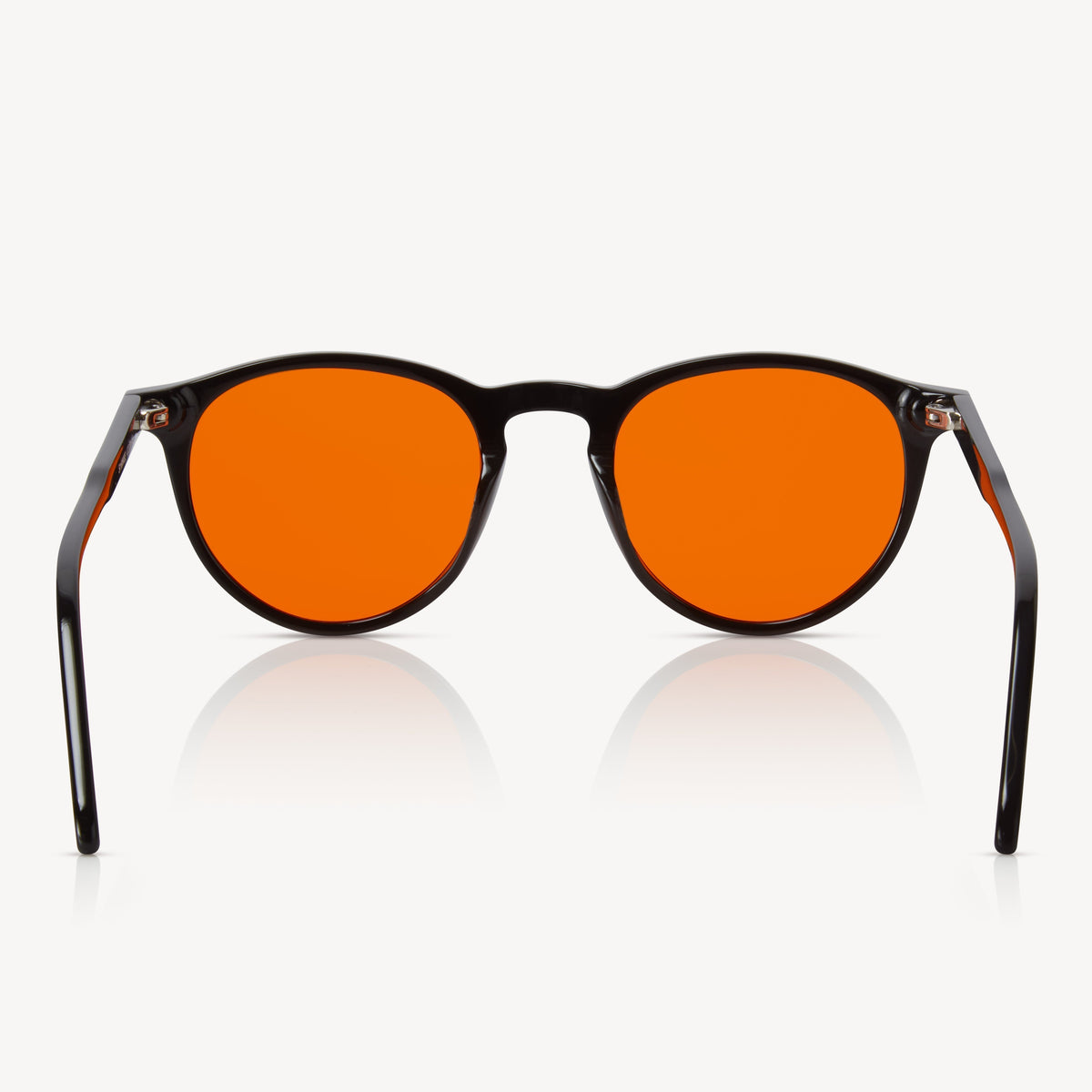
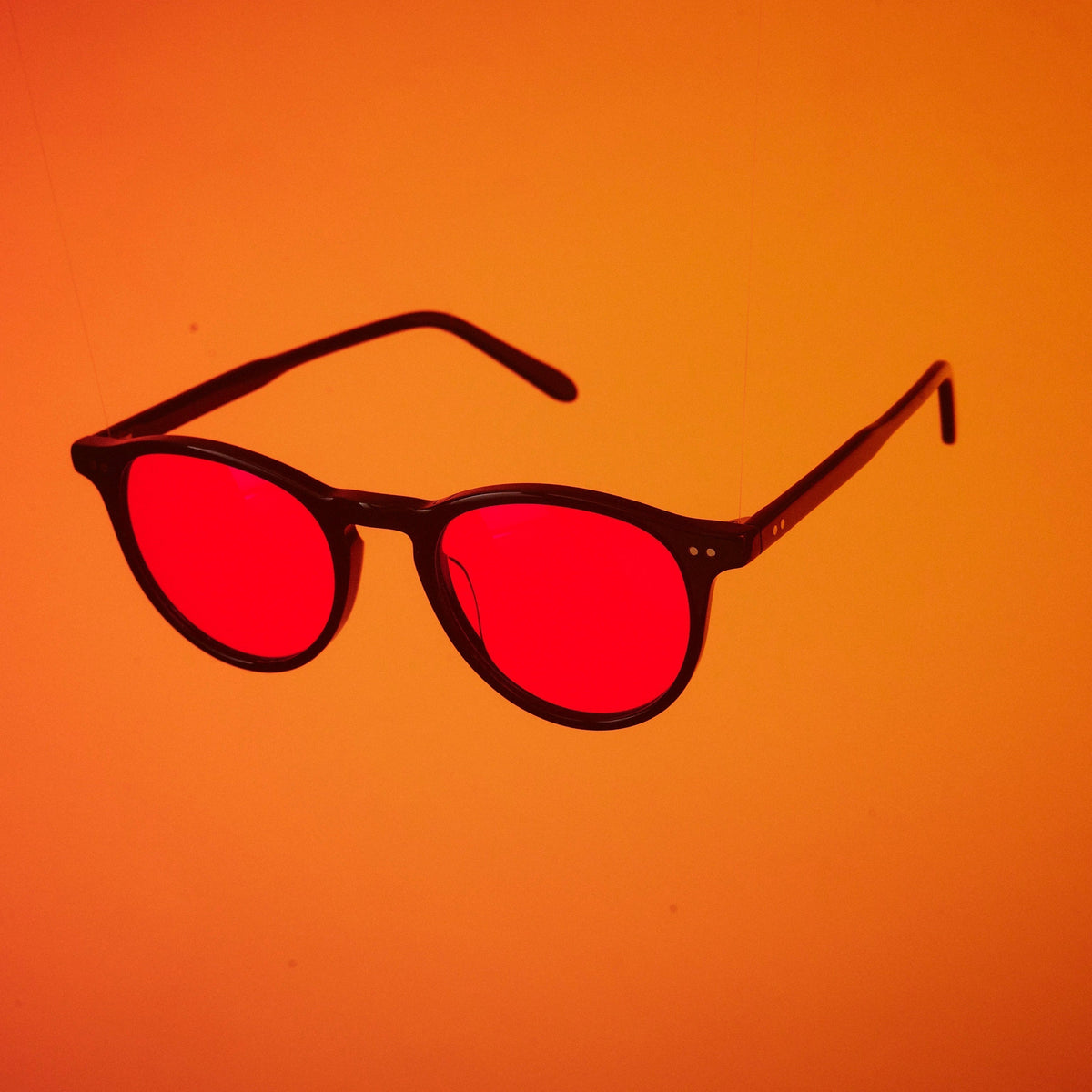
Yes, there's a visible tint; that's what filters the blue wavelengths. Everything stays sharp and clear to look through, just with a warmer cast, so if you're on a call or streaming in the evening, expect a slight amber tone.
SOURCES
-
Singh et al. (2023) — Blue-light filtering spectacle lenses for visual performance, sleep, and macular health in adults
-
Singh et al. (2021) — Do Blue-Blocking Lenses Reduce Eye Strain From Extended Screen Time?
-
Luna-Rangel et al. (2025) — Efficacy of blue-light blocking glasses on actigraphic sleep outcomes
-
College of Optometrists — Blue-Blocking Spectacle Lenses
-
Association of Optometrists (2023) — Visible Blue Light
-
Burkhart & Phelps (2009) — Amber lenses to block blue light and improve sleep
-
Shechter et al. (2018) — Blocking nocturnal blue light for insomnia
-
West et al. (2011) — Blue light from light-emitting diodes elicits a dose-dependent suppression of melatonin in humans
-
Cajochen et al. (2011) — Evening exposure to a light-emitting diodes (LED)-backlit computer screen affects circadian physiology and cognitive performance
-
Chang et al. (2015) — Evening use of light-emitting eReaders negatively affects sleep, circadian timing, and next-morning alertness
-
Lin et al. (2017) — Short-Wavelength Light-Blocking Eyeglasses Attenuate Symptoms of Eye Fatigue